
Corporate Retreat Planning: A Practical Guide for Teams

A good corporate retreat starts with one decision, not a venue: what needs to be true on the Monday after you return that isn’t true today. Answer that, and the rest of the plan (length, location, agenda, activities, budget) gets much easier. This guide walks through each step the way we would if you called us to talk it over, and it shows where the lodging itself can help or hurt the outcome.
TL;DR
-
Define one concrete outcome before you book anything. “Better bonding” is not an outcome; a decision, an alignment or a shared plan is.
-
Most retreats run one to three days. Strategic planning usually needs two to three, team building two to four.
-
Protect free time. The conversations that matter often happen on the deck, not in the session.
-
Set behavior expectations in writing before departure, and keep expense records so reimbursements stay clean.
-
For groups of 10 to 19, one shared house often beats a hotel block, because the team stays together.
Table of Contents
Start with the Monday morning question
Planners often begin with a place: somewhere scenic, somewhere easy to reach. We’d start one step earlier. Cvent’s offsite guide frames a test worth borrowing: before you book a single vendor, ask what specific decision, alignment or outcome needs to be true when everyone is back at work. If your answer is vague, the retreat isn’t ready to be booked.
Here is how that sounds in practice:
-
Weak: “We want the team to connect.”
-
Better: “Sales and product leave with one shared list of three priorities for next quarter.”
-
Better: “The new leadership group agrees on how it makes decisions and who owns what.”
-
Better: “Two teams that rarely talk leave with a working agreement on handoffs.”
Mind Tools starts its own step-by-step plan the same way, by asking what problem the retreat needs to solve. Write your answer in a sentence or two and share it with the people who’ll attend. It becomes the filter for every later choice.
Decide who comes and what kind of retreat it is
The purpose shapes the guest list. A few common types:
-
Strategy retreat. Leadership or department heads, often 6 to 15 people. Heavy on working sessions.
-
Team-building or culture retreat. A whole team or company. More shared meals, more activities, more open time.
-
Kickoff or planning retreat. A team starting a new project or year, with a mix of working sessions and social time.
-
Executive retreat. A small group, often with a facilitator, focused on a few hard decisions.
Be deliberate about size. Groups under 20 have an advantage that large conferences don’t: everyone can sit at the same table. That changes the kind of conversation you can have.
How long should a corporate retreat be?
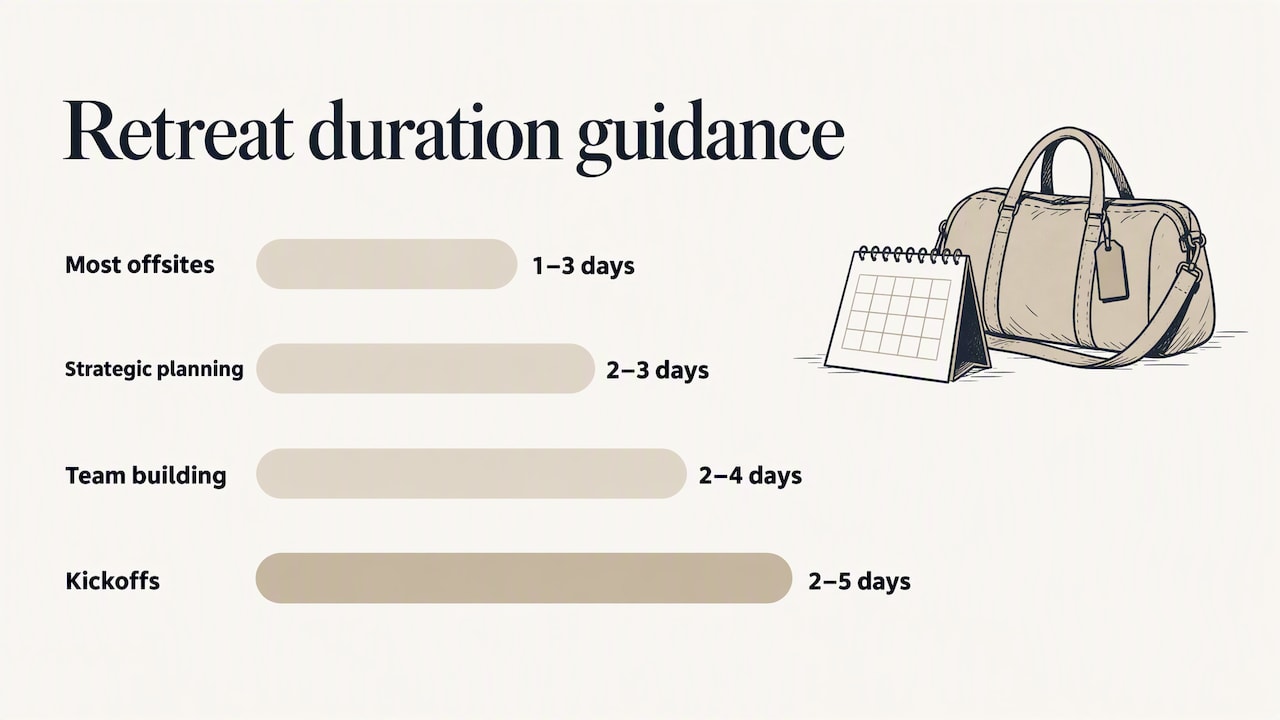
Cvent’s guidance points to a range of one to three days for most offsites, with strategic planning at two to three days, team building at two to four, and kickoffs at two to five. Those are guidelines, not rules. Your travel time, your team’s caregiving commitments and your budget all push the number up or down.
One practical note: if people travel half a day each way, a two-day retreat gives you one real working day. For a drive-to destination, count arrival evening as part of the schedule, because a shared dinner on night one does real work.
Build a budget that includes the unglamorous lines
The lodging price is rarely the full cost. Build your budget around these categories:
| Category | What to include |
|---|---|
| Lodging | Nights per person or per property, cleaning or service fees, taxes |
| Food | Meals, snacks, coffee, evening drinks if you choose to provide them |
| Travel | Fuel, rental vehicles, flights, shuttles |
| Program | Facilitator, supplies, activity fees, equipment rentals |
| Meeting needs | Screens, whiteboards, printing, wifi reliability |
| Buffer | A cushion for changes and no-shows |
One comparison planners often miss: a single large house shared by the group can replace several separate costs, including meeting rooms, a private dining space and an evening venue. Ask any venue what’s included in the nightly rate, and what is billed on top.
Keep the tax paperwork clean
If your company reimburses retreat travel, meals and lodging, the IRS describes how this works in Publication 5137 on accountable plans: reimbursements under an accountable plan are generally not treated as wages, provided the plan’s requirements are met. Those include a business connection for the expenses, substantiation of what was spent, and returning any excess advances. Keep receipts, a written agenda and an attendee list. Because your situation depends on how your company structures its policy, run the details past your accountant or tax adviser before you finalize the budget.
Choose a venue that fits the work
This is where most teams spend the most time, so use criteria rather than gut feel:
-
Travel ease. How long will the slowest traveler take to arrive? Long, complicated trips drain energy before day one.
-
Sleeping arrangements. Can everyone have a real bed and some privacy? Forced sharing can sour the mood fast.
-
Room to work. You need a space where everyone can sit together, see a screen and talk without shouting.
-
Room to not work. Separate spaces for quiet time, small conversations and play.
-
Food. A full kitchen and room to cook together can become part of the program, or you can arrange catering.
-
Atmosphere. Does it feel like the office with a different carpet, or like somewhere new?
-
Season. What’s around that makes the free time good: snow, trails, water, fire pits?
The main alternatives are a hotel with meeting rooms, a conference center, a camp-style facility or a large private house. Hotels give you service and standard meeting rooms. A private house gives you privacy, a shared living space and the ability to run your own rhythm. Neither is better in the abstract; it depends on whether your retreat needs polish or closeness.
Design an agenda people don’t dread
The most common agenda mistake is packing every hour. Offsite’s planning guide recommends treating unstructured time as a core part of the program, ideally 30 or more minutes for every hour of structured work. That sounds like a lot until you’ve watched a team sit in back-to-back sessions and then light up over a late-night card game.
A two-and-a-half-day sample shows the shape:
Day 1 (arrival)
-
Afternoon: arrive, settle in, pick rooms
-
Early evening: relaxed welcome and a shared dinner
-
Evening: a light, optional activity such as a game night or fire pit
Day 2 (the work day)
-
Morning: a short check-in, then the main working session on your central question
-
Midday: long lunch and a walk or outdoor break
-
Afternoon: breakout groups, then reconvene to decide
-
Evening: team-cooked dinner or something fun, with no agenda
Day 3 (close)
-
Morning: review decisions, assign owners and dates
-
Late morning: a final shared activity or breakfast, then travel home
End the last session with owners and deadlines written down. That’s what carries the retreat into Monday.
Retreat activities that actually build something
Team retreat activities fall into three groups. Use all three, in proportion to your purpose.
Work-linked activities
SHRM’s guidance on team building says to start from a team objective, not an activity catalogue. If two groups struggle to share information, design a joint problem-solving exercise that mirrors that gap. Good options include:
-
Mixed-team planning sprints on a real upcoming challenge
-
A “what we should stop doing” session
-
Pairing people from different functions to explain each other’s work
-
A short retrospective on last quarter, run by someone other than the manager
Shared experiences
These give people something to talk about that has nothing to do with the job:
-
Cooking dinner together in teams
-
A hike, snowshoe outing or ski day, with options for every comfort level
-
Karaoke, trivia or a tournament in a game room
-
An evening around a fire pit
Offer a choice wherever you can. Not everyone wants to sing, and the best retreats make joining in feel optional.
Rest and recovery
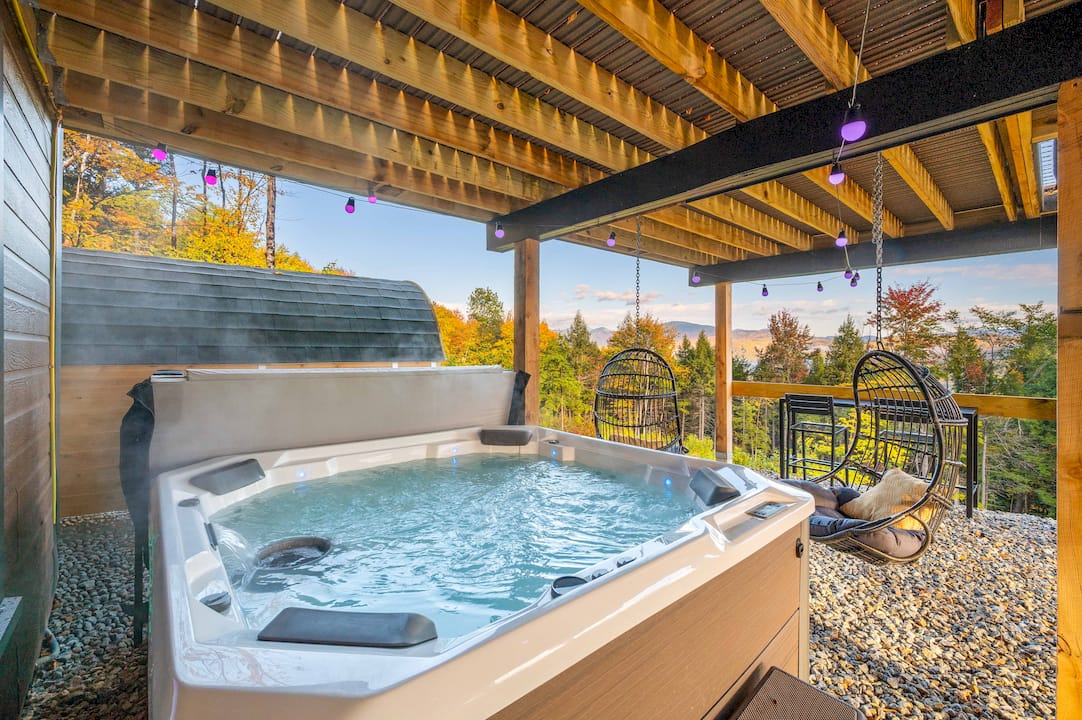
A hot tub, a sauna, a quiet corner with a book. Treat these as programmed time, not afterthoughts. People who’ve had a chance to decompress contribute more the next morning.
Build psychological safety into the design
The goal of many retreats is more honest conversation. Research gives some guidance on how to get it. An American Psychologist article describes psychological safety as a shared belief that it’s safe to take interpersonal risks, and treats it as central to effective teamwork. A study in the Journal of Applied Psychology on leader humility links leaders admitting limits and mistakes to better information sharing and creativity in teams, with results that vary by team context, including how people view power distance.
What this means for your plan:
-
Ask leaders to go first when sharing a mistake or a question they don’t have answers to.
-
Keep sessions small enough that quieter people get airtime.
-
Avoid forced vulnerability exercises. Invite, don’t require.
-
Make decisions visible, so people see their input matters.
Set expectations before anyone packs a bag
Retreats blur the line between work and social life. SHRM’s August 2026 piece on work boundaries recommends clearly defined behavioral expectations at all company events, applied consistently, which helps reduce legal ambiguity and protects both employees and the organization.
In practice, send a short note ahead of time covering:
-
Conduct expectations, the same as at the office
-
Your approach to alcohol (provided or not, limits, and no pressure to drink)
-
Participation: which activities are optional
-
Rooming arrangements and privacy
-
Dietary, accessibility and mobility needs, with a named person to contact
Have HR or a senior leader review it. If your company has specific legal questions, your employment counsel is the right person to ask.
A planning timeline that works backward from the date
Don’t compress this. Venues for groups of 15 or more can fill up on weekends and holidays, and every vendor needs lead time. A reasonable sequence:
-
Several months out: define the outcome, the guest list, the budget and the rough dates.
-
A few months out: shortlist and book the venue. Confirm what’s included in the rate and read the cancellation terms.
-
Two to three months out: draft the agenda, line up a facilitator if needed, plan food and transportation.
-
One month out: send logistics, the conduct note and the packing list. Collect dietary and access needs.
-
Two weeks out: reconfirm every reservation and delivery, and finalize the schedule.
-
After: send a short survey and, within a week, a list of decisions and owners.
Measure success against your Monday-morning sentence, not against how much fun everyone had.
Our perspective on group retreats
We built Altitude 22 in Bethel, Maine, for groups that want more than a place to sleep, and we’ve thought a lot about what happens when a team shares a house. Here’s what we believe.
The room matters more than the agenda. When people share a kitchen, a living space and a deck, small moments happen without scheduling: someone makes coffee for the person they’ve never really talked to, someone teaches someone else a game. You can’t put that on a calendar, but you can give it space.
We also believe in options. Our house has a karaoke lounge, game rooms, a home theater, a heated pool, a hot tub and a barrel sauna, so a group with different energy levels can split up and come back together. The quiet person and the life of the party both have somewhere to be.
Finally, good hosting is invisible. The best compliment a team can give is that nobody had to think about logistics. If you want to understand why we built the place this way, read our story.
Hosting your retreat at Altitude 22
If your team is planning a gathering in the Northeast, Altitude 22 is a private group retreat in Bethel, Maine. It has 6 bedrooms, 5.5 bathrooms and sleeps up to 19. Beyond the bedrooms you’ll find a modern kitchen, a large deck, fire pits, a home theater, a kids’ gaming suite, and easy access to Sunday River Resort and nature trails. It suits leadership offsites, team-building weekends and company gatherings that include families. See the details and availability on our main site.
FAQ
How far ahead should I start planning a company retreat?
Start several months out, ideally before you commit to a date. Goals and budget come first, then the venue, then logistics. The sooner you book a large group property, the more date options you have, especially around holidays and peak seasons.
How much does a corporate retreat cost?
It varies with group size, location, length and program. Build a budget around lodging, food, travel, program costs and a buffer, and ask each venue what its rate includes. For a group of 15 or more, a shared house can reduce spending on meeting space and evening venues compared with a hotel.
Are retreat expenses tax-deductible or reimbursable?
IRS Publication 5137 explains that reimbursements under an accountable plan are generally not counted as wages when the plan requirements are met, including business connection and substantiation. Deductibility depends on your company’s situation, so confirm the details with your accountant or tax adviser.
What should a retreat agenda include?
One or two focused working sessions tied to your central outcome, shared meals, optional social activities and plenty of open time. Aim for roughly 30 minutes of free time for every hour of structured work, and end with decisions, owners and deadlines.
Can a retreat include families or non-work guests?
Yes, if your purpose allows it, but separate the work time from the family time clearly. A property with space for kids, such as a gaming suite, helps parents stay present in sessions and enjoy the rest.
Sources
-
Future Focus: Work Boundaries, the Joyconomy, and AI Fluency, SHRM
-
Leader humility and team creativity, Journal of Applied Psychology
Recommended
Ready To Book Your Stay
Whether it’s a long-planned trip or a spontaneous getaway, this home was created to make being together feel easy and intentional.
